Monday, June 4, 2018
How Long Will the Dollar Runup Last?
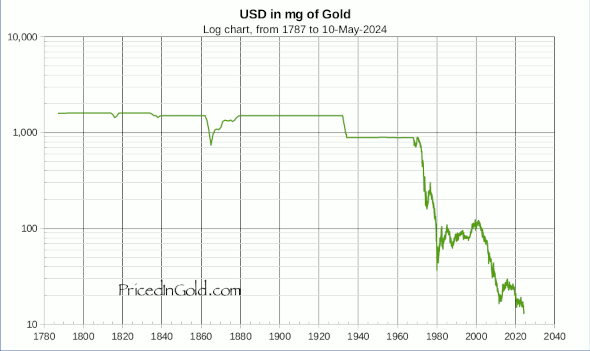
Below is a picture of the log of the dollar valued in milligrams of gold. The sharp decline in the dollar began around 1971, following the Great Society and around the time of the abolition of the gold standard in 1971. The Great Society and mega-government of the LBJ and Nixon eras and the post-Reagan stock market bubble have been funded with paper money. Before then the dollar was relatively stable. The source of the chart is PricedinGold.com . (See the chart here.) The inflection point that worries people holding gold now is the local bottom. My late friend Howard S. Katz wrote about the commodity pendulum whereby Fed monetary expansion reduces the cost of capital, expands the number of miners, pushes down the cost of gold and other commodities, causes bankruptcy among the miners, which in the end results in a whipsaw and additional sharp leg down in the dollar and up in gold. You can see that in the post-1983 Reagan reflation pattern, which ended with the stock market correction of 2000 and an additional sharp decline in the value of the dollar. The question is whether the massive monetary expansion of 2008-2014 will result in an even greater upturn in the value of the dollar than the 1983-2000 upturn. That is, will the current upturn in the dollar's value continue for 17 years or more, as did the 1983-2000 upturn in the value of the dollar. I don't claim to know the answer, but gold miners have sold at depressed levels for some time.


Sunday, May 27, 2018
Social Security Is a Welfare, Not a Pension, Plan
I'm going to be 64 this week, so I've been thinking about Social Security, a program I've actively opposed since the 1970s but one in which I have been compelled to participate.
Social Security is a welfare and not an insurance plan. Its advocates claim that it is both, but that is impossible. Insurance is actuarially fair: It spreads the risk of loss fairly across a population. In contrast, welfare plans are redistributive: They compel some to give up wealth to subsidize others.
There are legitimate reasons to support welfare and charity, and there are legitimate reasons to reject political lying. In order to convince Americans to accept Social Security, the Democrats pretended that it is a fair insurance plan. To do so, they created a deception that the taxes into Social Security, FICA, are insurance premiums even though there is no legal connection between FICA and Social Security benefits.
They also created a deception that there is a Social Security fund that is equivalent to a pension fund and that FICA taxes build someone's fund, which is returned in retirement. There is a fund, but it is more in the nature of a cash box than a pension fund. Social Security has always been primarily a pay-as-you-go system. A relatively large excess accumulated because of the temporary Boomer population bubble, but that would have dissipated had the politicians not (legally) looted the fund.
Democratic Party politicians gave voters the impression that FICA is a contribution to an insurance plan and not a regressive income tax. Many voters also believe that their Social Security benefits equate to their contributions.
Social Security benefits do not equate to contributions. The use of wage bands allocates higher benefits per dollar to lower-wage participants. Disability benefits are more heavily distributed to actuarially identifiable groups, but there is no charge to those groups.
Anyone who does not benefit from salary bands or disability benefits is unlikely to participate in Social Security. Hence, the Democrats had to make the plan authoritarian and compulsory. The authoritarianism and compulsion seal Social Security's status as a welfare rather than an insurance plan.
Insurance is an economically fair method of managing risk, and risk-averse consumers need no compulsion to purchase it. Social security is not economically fair; it is equivalent to any other form of welfare. Hence, there is limited economic motivation, save altruism, for net contributors to participate.
Saturday, May 26, 2018
My Interview on Redeemer Broadcasting
Dan Elmendorf of Olivebridge, NY interviewed me on his Redeemer Broadcasting radio chain, which has seven stations in upstate New York, New Jersey, and Maryland. The interview will air on May 27, and it is linked here. The stations include WFSO, WNEQ, WYNE, and WXMD. The interview concerns the link between university scientism and political intolerance.
Friday, May 25, 2018
Speak Freely
George Leef of the James Martin Center has an excellent review of Princeton University's Keith Whittingon's new book Speak Freely. The analogy between the treatment of liberal, Jewish law professor Ernst Cohn by Nazi students at the University of Breslau in 1933 and the treatment of conservative faculty at elite American universities in 2018 is apt.
Subscribe to:
Posts (Atom)


